How to Get Your Content Cited by ChatGPT and Perplexity
To get cited by ChatGPT and Perplexity, let their crawlers in, put a direct 40-80 word answer under every question-style heading, and back it with specific, dated, original facts. Perplexity cites on almost every answer, while ChatGPT cites only when its search mode runs, so clear, extractable, fresh pages are what win those few slots.
If you want to know how to get your content cited by ChatGPT and Perplexity, start with a change of mindset: you are no longer writing only to rank, you are writing to be quoted. A citation happens at the moment an AI engine assembles an answer, pulls a handful of pages, and decides which ones support the claims it is about to make. Your page either offers a clean, verifiable, easy-to-lift statement, or it gets skipped.
This guide rewrites the playbook from scratch. It covers what a citation actually is, how the two engines pick sources, the page structure that gets lifted, the technical checks that decide whether you are even in the candidate pool, and a seven-step routine you can apply this week.
- Perplexity cites sources on nearly every answer; ChatGPT only cites when its search mode is triggered.
- Perplexity typically lists 3-8 sources per answer, and ChatGPT search usually shows 3-5, so you compete for a shortlist, not a podium.
- Paragraphs of 40-80 words placed directly under a heading are the units most often lifted verbatim.
- A visible publish or update date matters most for time-sensitive topics such as prices, stats and comparisons.
- Original numbers (your own benchmark, survey or case data) beat restated third-party statistics.
What does it mean for content to be cited by an AI answer engine?
A citation means the engine's answer includes a link, footnote or named attribution to your domain because it used your page as a source for a fact, quote or claim. Google ranking is a different game: it decides where you appear in a list a human scans, while a citation is decided at answer-generation time by a model that has retrieved a few pages and is choosing which ones to lean on.
Perplexity makes this the most visible. Almost every answer carries numbered markers like [1][2][3] that map to the exact pages used. ChatGPT is less consistent. In plain conversational mode it answers from training data and shows no sources at all. When a query triggers web search, or when the user opens the search experience, it retrieves live pages and shows source links much like Perplexity does.
Two practical consequences follow:
- You can be cited without ranking first. Retrieval shortlists are built differently from classic blue-link rankings, so a well-structured page from a modest site can beat a stronger domain whose answer is buried.
- A mention is not a citation. Being named in the model's training data helps brand recall, but only a retrieved, attributed source sends a measurable visit back to you.
How do ChatGPT and Perplexity actually choose which sources to cite?
Both engines run a retrieval step before they write. They query the live web or a recent index, pull back a shortlist of candidate pages, and the language model then picks which snippets to quote or paraphrase based on relevance and clarity. Pages that answer the query directly in their first sentences are far more likely to be selected than pages that bury the answer under an introduction.
Three factors dominate the selection:
- Topical match. Does the page's main heading and first paragraph clearly address the exact query? A page titled around the question, with the answer right beneath it, matches faster than a broad overview.
- Extractability. Is the fact stated in a short, self-contained sentence, or spread across three paragraphs of context? Models prefer a sentence they can lift without rewriting.
- Trust signals. Domain reputation, recency, named authorship, and whether other credible sites repeat the same claim all push a page up the shortlist.
Original data deserves special mention. If you publish a number nobody else has, such as a benchmark from your own accounts or a count from your own audit, the engine cannot find it restated everywhere, so your page becomes the natural source. The same principle sits behind writing fact-dense content that AI engines quote: specifics create reasons to cite.
What content structure gets cited most often?
The structure cited most often is a question-style heading followed immediately by a direct 40-80 word answer, then detail below. It mirrors how Google featured snippets work, and for the same reason: both systems are looking for a self-contained answer they can lift without editing.
The formats that consistently get pulled into AI answers:
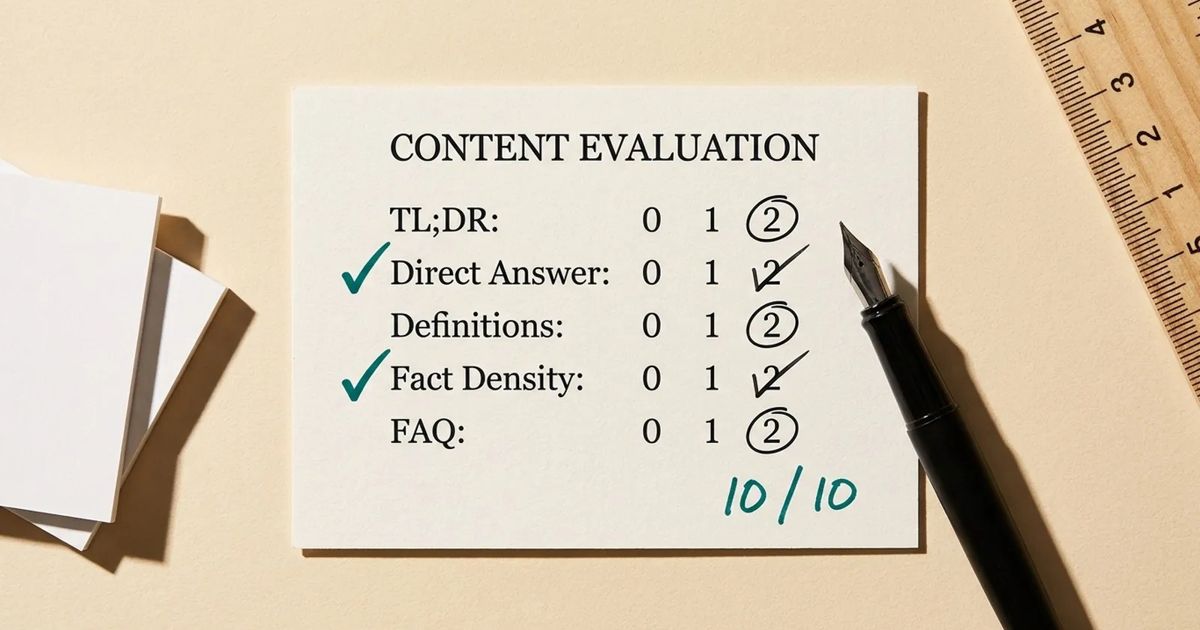
- Answer-first paragraphs. State the verdict in the first one or two sentences under each H2 or H3. Caveats, exceptions and examples come after.
- Numbered steps. For "how do I..." queries, both engines quote ordered lists almost verbatim, so number your steps and keep each to one action.
- Comparison tables. Tabular data is easy to reformat and is regularly reproduced in AI answers, more so than the same comparison written as prose.
- Named, dated facts. "In a 2024 audit of 500 pages" is quotable. "Studies show" is not. Attach a source, a year and a number wherever you can.
- Explicit definitions. Define each key term once in a sentence of the form "X means..." so the definition itself can be cited.
Here is a before-and-after on the same fact. The weak version: "There are many considerations when thinking about how freshness might influence whether AI tools pick your page, and it can vary." The citable version: "Perplexity weights freshness heavily, so update time-sensitive pages at least quarterly and show the date near the top." Same topic, but only the second can be dropped straight into an answer.
How many sources do AI engines cite per answer, and does position matter?
Perplexity typically cites between 3 and 8 sources per answer, while ChatGPT's search mode usually surfaces 3 to 5. Being the single most-cited source is rare on competitive queries, so the realistic goal is to be one of the handful of pages in the shortlist rather than the only one.
That changes how you should measure success. Skip the single "rank" and track how often your domain appears across a fixed set of 20-30 target questions, checked monthly in both engines. A page that appears in 6 of 30 answers is doing real work even if it is never source number one.
| Signal | Perplexity | ChatGPT (search mode) |
|---|---|---|
| Citations shown by default | Yes, on nearly every answer | Only when search/browsing is triggered |
| Typical sources per answer | 3-8 | 3-5 |
| Freshness weighting | Heavy, favors recently crawled pages | Moderate, mixes fresh results with training knowledge |
| Preferred content format | Lists, tables, short answer paragraphs | Short answer paragraphs, direct quotes |
| Domain trust weighting | High, established domains favored | High, but original data can offset lower authority |
The table also shows where to invest first. If your audience uses Perplexity, freshness and list/table formatting pay off quickly. If it is ChatGPT, short quotable paragraphs and distinctive data matter most. Either way the structural fixes are the same, which is why they are worth doing once and doing well.
What technical signals decide whether AI crawlers can reach your content?
If an engine's crawler cannot fetch and read your page, nothing else matters, because you are simply not in the candidate pool. Perplexity uses PerplexityBot, and OpenAI uses OAI-SearchBot (for search) and GPTBot (for training); all of them must be allowed in your robots.txt, and your key content has to exist in the initial HTML rather than appearing only after heavy JavaScript runs.
Run this checklist before you touch a single sentence:
- Check robots.txt. Confirm GPTBot, OAI-SearchBot and PerplexityBot are not disallowed. A blanket
Disallow: /for unknown bots is the most common accidental block. - Server-render the answer. Headings and the answer paragraph should be visible with JavaScript disabled. Open the page, view source, and search for your first answer sentence.
- Show a last-updated date. Put it near the top, and keep it honest: update it only when the content genuinely changed.
- Add structured data. Use Article, FAQPage and Organization schema so authorship and topic are unambiguous to a parser.
- Remove login and cookie walls from pages you want cited. Content behind a gate cannot be retrieved.
- Keep the page fast and indexable. A noindex tag or a redirect chain can quietly exclude a page from retrieval.
- Interlink related pages so retrieval systems see depth around the subject, not one isolated post. This is the same logic as building topical authority, and it is why a single strong article beats a standalone listicle.
One caution: allowing the bots is a business decision as well as a technical one. If you prefer not to be used for model training, you can disallow GPTBot while still allowing OAI-SearchBot, so search-time citations remain possible.
What is a repeatable routine to make a page citable this week?
A citable page can be built in about two hours by auditing the heading structure, rewriting answers into extractable blocks, and adding one original data point. The routine below is deliberately short so you can run it on your top five pages rather than endlessly planning.
- List the questions. Write the 5-8 real questions a customer asks that this page should answer, in the exact phrasing they would type.
- Turn headings into questions. Rewrite each H2 as one of those questions instead of a label like "Overview".
- Answer in the first two sentences. Under each heading, give the direct answer in 40-80 words, then add context.
- Add one original fact. A count from your own data, a time measured on your own project, a price you actually charge. Date it.
- Convert one comparison to a table and one process to a numbered list.
- Define each key term once in a plain "X means..." sentence.
- Fix the technical basics from the checklist above, then stamp a real update date.
- Re-test. After two to four weeks, ask the same 20-30 questions in Perplexity and in ChatGPT with search on, and log whether your domain is cited.
If you would rather not run that cycle by hand across a whole site, a structured 30-day growth plan turns it into a scheduled batch of pages written in this answer-first format.
Once your pages are structured, decide what to publish around them. Educational pages earn citations and product pages earn conversions, and the balance matters, as covered in product vs educational content: the right mix for GEO. If you work in a regulated vertical where trust signals weigh even more, the planning logic in this YMYL content calendar template applies directly. And for the foundations behind all of this, start with what GEO is and how to optimize for AI answer engines.
What mistakes quietly stop pages from being cited?
The most common mistake is burying the answer. A 300-word introduction before the first useful sentence makes a page hard to extract and easy to skip, because engines retrieve a short list of candidates quickly and favor the page that gets to the point.
The other recurring problems are easy to spot once you know them:
- Vague claims. "Many experts agree" gives a model nothing to attribute. Name the source, the year and the number.
- Stale dates. A 2021 article on a topic where figures change yearly will lose to a recently updated page, especially on Perplexity.
- Blocked or invisible content. Robots rules, noindex tags and client-side-only rendering all remove you from the pool before quality is judged.
- Label headings. "Introduction" and "Benefits" do not match a question; "How long does it take to see results?" does.
- One-off pages. A single article with no related pages around it looks thin. Depth across a cluster signals that you genuinely own the topic.
- Chasing tricks. There is no hidden markup or prompt trick that forces a citation. Clear structure, specific facts and crawl access are the whole game.
Citation is a byproduct of being the clearest, most specific, most accessible answer to a real question, and the rest follows.